
Hidden Disabilities Sunflower
The Hidden Disabilities Sunflower is an internationally recognised symbol that lets people discreetly indicate they have a non-visible disability or health condition and may need a little more time, patience, or support.
It is used by many people with conditions such as ME/CFS, Long COVID, Fibromyalgia, Autism, ADHD, epilepsy, hearing loss, mental health conditions, and many others, to name but a few.
Many airports, supermarkets, transport providers, hospitals, visitor attractions and businesses recognise the scheme, although the support available varies between organisations.
Good to know: The Sunflower is completely voluntary and does not provide legal rights, priority access, or financial supports. It simply helps communicate that you may need understanding or assistance.
Official website: https://hdsunflower.com/
JAM Card (Just A Minute)
The JAM Card allows you to discreetly tell someone that you need a little extra time during conversations or everyday interactions without having to explain your condition.
It can be particularly helpful for people living with brain fog, fatigue, speech difficulties, anxiety, autism, learning disabilities, or cognitive impairments.
The card is recognised by many organisations throughout Ireland, including public services, transport providers, retailers and healthcare settings. It is available as both a physical card and a mobile app.
Good to know: The card does not identify your diagnosis. It simply lets others know you may need a little more time.
Official website: https://jamcard.org/
European Disability Card & European Parking Card
The European Disability Card and European Parking Card are new European Union initiatives designed to make travelling between EU countries easier for people with disabilities.
The European Disability Card will provide a recognised proof of disability across participating Member States, helping people access disability related services and concessions while travelling. Depending on the country you are visiting, this may include discounted admission, companion tickets, accessible transport, or other disability supports available to local residents.
The European Parking Card will replace the existing EU parking card with a standardised version recognised across participating countries. It is intended to make it easier for eligible disabled motorists and passengers to access parking concessions while travelling within the European Union.
Although both cards will be recognised across participating Member States, each country will continue to decide what services and concessions are available, so entitlements may vary depending on where you are travelling.
Good to know: These cards do not create a single European disability assessment or replace your country's own eligibility rules. They simply make it easier for your disability status and parking entitlements to be recognised when travelling abroad. The EU Disabbility card is currently issued only in 8 pilot countries: Belgium, Cyprus, Estonia, Finland, Italy, Malta, Romania, and Slovenia.
Official information: European Commission: European Disability Card & European Parking Card
Airport Assistance
If travelling through an airport feels overwhelming or physically difficult, you can request special assistance before your journey. This free service is available to passengers with disabilities, reduced mobility, and many non-visible conditions.
Support can include assistance through the airport, help with luggage, wheelchair services, priority boarding, and guidance through security and passport control where appropriate. Most airlines recommend requesting assistance at least 48 hours before you travel, although many airports can also arrange support at shorter notice where possible.
Good to know: You do not have to be a wheelchair user to request airport assistance. Many people with fatigue, chronic pain, neurological conditions, or sensory difficulties also benefit from the service.
Official information:
Dublin Airport Passenger Assistance
Cork Airport Passenger Assistance
Irish Aviation Authority Passenger Rights
Companion Tickets & Carer Discounts
Many cinemas, theatres, museums, visitor attractions, sporting events, and entertainment venues offer free or discounted tickets for a companion or carer when someone requires assistance to attend. Eligibility varies between organisations and may require proof of disability, such as a disability parking permit, disability payment, Access Card, or other supporting documentation. Some venues advertise these schemes clearly, while others only provide them if you ask before booking.
Good to know: If you need another person to accompany you because of your disability, it is always worth asking whether a companion ticket scheme is available, even if it is not mentioned on the website.
Find out more:
Check the accessibility section of the venue's website or contact their customer service before booking.
Priority Seating & Accessibility Services
Many stadiums, concert venues, theatres, museums, and visitor attractions provide accessibility services for disabled visitors. These may include accessible seating, companion tickets, lifts, wheelchair spaces, accessible toilets, sensory rooms, hearing assistance, accessible parking, or alternative queue arrangements.
The support available varies between venues, so it is always worth checking their accessibility page before booking tickets or travelling. If you cannot find the information you need, contact the venue directly, as many accessibility services need to be arranged in advance. Many places will have disabled parking, or seated areas at outdoor gigs for example, but the spaces may be limited so check with them well ahead of time.
Good to know: Accessibility support is not limited to wheelchair users. Many venues can also assist visitors with hidden disabilities, fatigue, sensory sensitivities, chronic pain, or mobility difficulties.
Examples
Changing Places & Accessible Toilets
Standard accessible toilets do not meet everyone's needs. Changing Places toilets are larger, specially equipped facilities designed for people who need additional space or equipment, including height adjustable changing benches and ceiling hoists.
Ireland has a growing network of Changing Places facilities, while many shopping centres, transport hubs, hospitals, and public buildings also provide accessible toilets.
Official information:Changing Places Ireland Good to know: Planning toilet locations in advance can significantly reduce stress when travelling or attending appointments.
Pee.ie Map
Use the interactive map below to find toilets across Ireland before travelling. You can also submit your own to the map. Some of the toilets are public, while others may be provided by a business or service, please support them where possible! This is an open source project on Google Maps and is kindly made free to use by pee.ie. Please support the work they do at ko-fi.com/peeie.
View full screen: Pee.ie Toilets of Ireland Map
Pharmacy Services
Many community pharmacies offer services that go beyond dispensing medication and can make managing long term conditions much easier.
Depending on your local pharmacy, you may be able to access home delivery, repeat prescription management, medication reminders, blister packs (also known as monitored dosage systems - I highly reccomend these if you take multople medications at varying times through out the day), and advice on taking multiple medications safely.
If leaving the house is difficult because of illness, fatigue, or mobility problems, it is worth asking your pharmacist what additional services they provide, as these can vary between pharmacies.
Good to know: Some pharmacies can liaise directly with your GP to help manage repeat prescriptions, reducing the number of appointments you need to organise. Many now have Phone APPs for ordering and you can often send a note or query directly to them there.
Find your local pharmacy:
HSE Pharmacy Services
Library Services
Your local library offers far more than just books. Many libraries provide free digital services and accessibility supports that can be especially helpful if leaving home is difficult.
Services available may include ebooks, audiobooks, magazines, newspapers, large print books, online learning resources, and in some areas, home delivery services for people who cannot easily visit the library.
Good to know: Library membership is free, and many digital resources can be accessed from home using your library card. There are no longer any fees for late returns and you can extend any loan online. If reading becomes difficult because of fatigue, pain, or brain fog, audiobooks can be an excellent alternative.
Official website:
Libraries Ireland
Food & Meal Services
Preparing meals can become one of the most physically and mentally demanding parts of the day when living with chronic illness. Fortunately, there are a growing number of services that can help reduce the energy spent shopping, cooking, and meal planning.
Online Grocery Shopping
Most major supermarkets now offer home delivery, allowing you to shop from home and avoid travelling, walking around the store, carrying heavy bags, and waiting at checkouts. Many also allow you to save regular shopping lists, making repeat orders quicker and easier.
Meal Kit Delivery
Meal kit services provide pre measured ingredients and recipe cards, reducing the amount of shopping and meal planning required. While cooking is still required, many people find they reduce the mental effort involved in deciding what to eat.
- HelloFresh Ireland
- Factor Meals (availability varies by country)
Meals on Wheels
Meals on Wheels services deliver prepared meals directly to people who may have difficulty shopping or cooking because of age, illness, disability, or reduced mobility. Availability varies by location, with many services run by local community organisations.
Find your local service:
Meals on Wheels Network Ireland
Quiet Shopping Hours
Some supermarkets provide quieter shopping periods with reduced lighting, music and announcements, making shopping more comfortable for people with sensory sensitivities or fatigue.
Good to know: ... and of course there's always the local chipper or takeaway!
Medical ID & Emergency Contacts
Most modern smartphones allow you to store important medical information that can be accessed during an emergency, even if your phone is locked.
You can include details such as medical conditions, allergies, medications, blood type, and emergency contacts. This information may be useful if you are unable to communicate with first responders or healthcare professionals.
It is also a good idea to add one or more emergency contacts labelled ICE (In Case of Emergency) so they are easier to identify.
Good to know: Review your Medical ID occasionally to make sure your medications and emergency contacts are up to date.
Find out more or see tutorials:
-
Apple / iPhone
Apple Medical ID
Video Tutorial: How to Set Up Medical ID -
Google / Android
Android Emergency Information
Video Tutorial: How to Set Up Emergency Information
Medical Alert Jewellery
Medical alert bracelets, necklaces, wallet cards, and wearable devices can communicate important health information if you are unable to do so yourself. They can include details such as medical conditions, allergies, medications, emergency contacts, or other information that may help first responders.
Medical alert jewellery may be particularly useful for people with epilepsy, diabetes, severe allergies, heart conditions, or any condition that could affect communication during an emergency.
Good to know: Many companies allow you to personalise your jewellery with a QR code or online medical profile that can be updated if your circumstances change.
Examples:
Accessible Cinema Screenings
Many cinemas offer screenings designed to make going to the cinema more accessible for a wider range of people. Depending on the venue, these may include:
- Relaxed screenings.
- Captioned screenings.
- Audio described screenings.
- Autism friendly screenings.
- Subtitled screenings.
Some cinemas also provide companion tickets, wheelchair spaces, hearing assistance systems, and accessible seating.
Good to know: Check your local cinema's accessibility page before booking, as available screenings vary by location.
Examples:
Accessible Outdoor Spaces & Heritage Sites
Getting outdoors can be a great way to relax, improve wellbeing, and spend time with family or friends. An increasing number of beaches, parks, forests, and visitor attractions now offer accessibility features that make outdoor spaces more inclusive.
Depending on the location, you may find beach wheelchairs, all terrain wheelchairs, accessible walking trails, boardwalks, mobility scooters, accessible viewing areas, free admission, Changing Places toilets, and other facilities designed to make visiting easier.
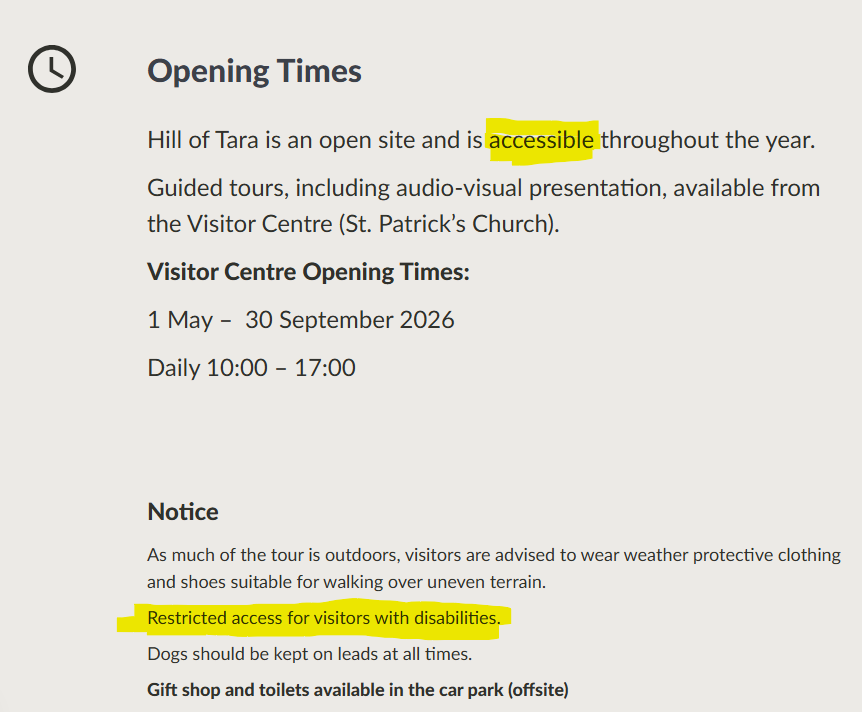
Many of these services are free to use, although some require booking in advance. If you're planning a day out, it's always worth checking a venue's accessibility information before travelling. If you are visiting a national heritage site, be sure to check the site's specific website for accessibility notes - sometimes a site may say it is "accessible", when they actually only mean it is open to the public, so check thoroughly in advance. See image below for an example:
Good to know: Beach wheelchairs are available at many locations around Ireland and are usually provided free of charge. Availability varies by beach and some locations operate a booking system, particularly during the summer months.
Useful resources:
Accessibility Features on Your Devices
Most smartphones, tablets, and computers include a wide range of built in accessibility features that many people never realise are available. These tools can make everyday tasks easier, reduce fatigue, and improve communication.
- Live Captions.
- Voice Control.
- Voice Access.
- Screen readers.
- Magnification.
- Reduced motion.
- Colour filters.
- Text size adjustments.
- Speech to text.
Good to know: Spending a few minutes exploring your device's accessibility settings can make a surprising difference to everyday life.
Find out more:
Useful Accessibility Apps
There are many free APPs designed to make everyday tasks more accessible. Some help with communication, while others assist with navigation, vision, hearing, or independent living.
- Be My Eyes – Connects blind and low vision users with volunteers through live video assistance.
- Seeing AI – Uses artificial intelligence to describe text, objects, and surroundings.
- Google Live Transcribe – Converts speech into real time captions.
- what3words – Helps emergency services and others identify precise locations using a unique three word address.
Good to know: Many accessibility apps are completely free and are available on both iOS (iPhones) and Android.
Official websites:
Patient Passports
Patient Passports, sometimes called Hospital Passports or Healthcare Passports, are documents that summarise important information about your health, communication needs, medications, allergies, sensory preferences, and the support you may need during appointments or hospital stays.
They can help reduce the need to repeatedly explain your circumstances and ensure healthcare professionals have key information available when treating you.
Many people choose to keep a printed copy in their bag alongside a digital version on their phone.
Good to know: Some hospitals and healthcare organisations provide their own Patient Passport templates, while others allow you to create your own.
Examples:
Practical Tip
Many organisations offer accessibility services that are not prominently advertised. If you are visiting somewhere new, it is often worth asking what support is available.